This is my first blog for the 2026 and I am willing to post more blogs this year. So, let’s get started!
I wanted to try something new with custom component on SItecore’s headless JSS with Next.js and for that I was trying to setup the boilerplate on my local machine as per the steps mentioned in the Sitecore’s development documentation here.
The Issue
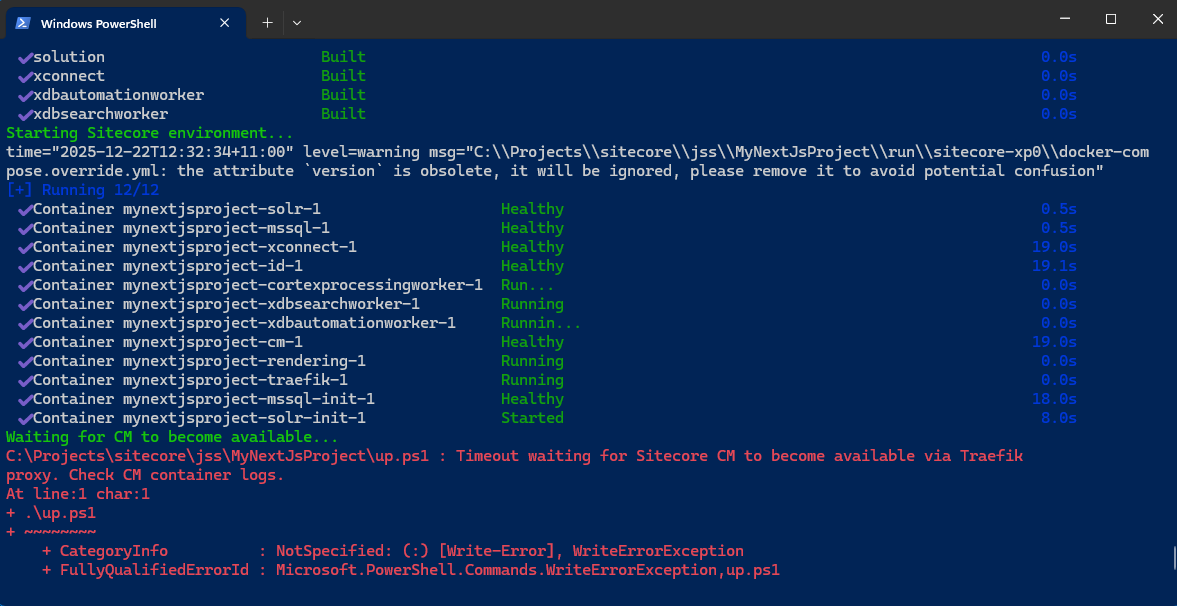
After the initialization, when I hit the .\up.ps1 command, I get below error message.
Waiting for CM to become available...
C:\Projects\sitecore\jss\MyNextJsProject\up.ps1 : Timeout waiting for Sitecore CM to become available via Traefik
proxy. Check CM container logs.
At line:1 char:1
+ .\up.ps1
+ ~~~~~~~~
    + CategoryInfo          : NotSpecified: (:) [Write-Error], WriteErrorException
    + FullyQualifiedErrorId : Microsoft.PowerShell.Commands.WriteErrorException,up.ps1
The solution
From above error message, I checked the logs in the folder \docker\data\cm. In the logs, there are errors for a solr indexes. But, I am sure from the past experience, these index error should not stop traefik proxy services to reach out to CM hosts.
This is the indication that there is something not right with the certificates needed for the ID and CM services. Checked and confirmed the valid wildcard certificates present at the path \docker\traefik\certs and that exact path is also configured correctly as volumes for the traefik service in docker-compose-override.yml
So, what is wrong now…!!!???
After few hours of debugging and googling… it turns out that the docker desktop version I am using is the culprit. The version I am using is the latest (at the time of writing this blog) 4.55.0 and the recommended version is 4.40.
I downgraded to the Docker Desktop 4.40, rerun all the images with rerun the .\up.ps1 command and it fired up all the containers without any error.
Update
I did try with Docker Desktop 4.44 and it is working absolutely fine with it as well.
After the upgrade Sitecore platform from 9.3 to 10.2 along with all compatible modules, one of our Content Author comes to me with an issue. The issue was the publishing of SXA web sites was bombing out with an error message.
The Issue
At the surface the issue was, the Publishing of SXA website was throwing below error.
Job started: Publish to 'web'|#Exception: System.Reflection.TargetInvocationException: Exception has been thrown by the target of an invocation. ---> System.AggregateException: One or more exceptions occurred while processing the subscribers to the 'item:deleting' event. ---> System.NullReferenceException: Object reference not set to an instance of an object.
   at Bynder.SitecoreConnector.Extensions.TemplateExtensions.IsDerived(Template template, ID templateId)
   at Bynder.SitecoreConnector.EventHandlers.BynderMediaItemEventHandler.OnItemDeleting(Object sender, EventArgs args)
   at Sitecore.Events.Event.EventSubscribers.RaiseEvent(String eventName, Object[] parameters, EventResult result)
   --- End of inner exception stack trace ---
   at Sitecore.Events.Event.EventSubscribers.RaiseEvent(String eventName, Object[] parameters, EventResult result)
   at Sitecore.Events.Event.RaiseEvent(String eventName, Object[] parameters)
   at Sitecore.Events.Event.RaiseItemDeleting(Object sender, ItemDeletingEventArgs args)
   at Sitecore.Events.Event.DataEngine_ItemDeleting(Object sender, ExecutingEventArgs`1 e)
   at System.EventHandler`1.Invoke(Object sender, TEventArgs e)
   at Sitecore.Data.Engines.EngineCommand`2.RaiseEvent[TArgs](EventHandler`1 handlers, Func`2 argsCreator)
   at Sitecore.Data.Engines.EngineCommand`2.RaiseExecuting(Boolean& cancelled)
   at Sitecore.Data.Engines.EngineCommand`2.CanExecute()
   at Sitecore.Data.Engines.EngineCommand`2.Execute()
   at Sitecore.Data.Engines.DataEngine.DeleteItem(Item item)
   at Sitecore.Publishing.PublishHelper.DeleteTargetItem(ID itemId)
   at Sitecore.Publishing.Pipelines.PublishItem.PerformAction.ExecuteAction(PublishItemContext context)
   at Sitecore.Publishing.Pipelines.PublishItem.PerformAction.Process(PublishItemContext context)
   at (Object , Object )
   at Sitecore.Pipelines.CorePipeline.Run(PipelineArgs args)
   at Sitecore.Pipelines.DefaultCorePipelineManager.Run(String pipelineName, PipelineArgs args, String pipelineDomain, Boolean failIfNotExists)
   at Sitecore.Pipelines.DefaultCorePipelineManager.Run(String pipelineName, PipelineArgs args, String pipelineDomain)
   at Sitecore.Publishing.Pipelines.PublishItem.PublishItemPipeline.Run(PublishItemContext context)
   at Sitecore.Publishing.Pipelines.Publish.ProcessQueue.ProcessPublishingCandidate(PublishingCandidate entry, PublishContext context, List`1& referrers, List`1& children)
   at Sitecore.Publishing.Pipelines.Publish.ProcessQueue.ProcessPublishingCandidate(PublishingCandidate entry, PublishContext context)
   at Sitecore.Publishing.Pipelines.Publish.ProcessQueue.ProcessEntries(IEnumerable`1 entries, PublishContext context)
   at Sitecore.Publishing.Pipelines.Publish.ProcessQueue.Process(PublishContext context)
   at (Object , Object )
   at Sitecore.Pipelines.CorePipeline.Run(PipelineArgs args)
   at Sitecore.Pipelines.DefaultCorePipelineManager.Run(String pipelineName, PipelineArgs args, String pipelineDomain, Boolean failIfNotExists)
   at Sitecore.Pipelines.DefaultCorePipelineManager.Run(String pipelineName, PipelineArgs args, String pipelineDomain)
   at Sitecore.Publishing.Pipelines.Publish.PublishPipeline.Run(PublishContext context)
   at Sitecore.Publishing.Publisher.PublishWithResult()
   --- End of inner exception stack trace ---
   at System.RuntimeMethodHandle.InvokeMethod(Object target, Object[] arguments, Signature sig, Boolean constructor)
   at System.Reflection.RuntimeMethodInfo.UnsafeInvokeInternal(Object obj, Object[] parameters, Object[] arguments)
   at System.Reflection.RuntimeMethodInfo.Invoke(Object obj, BindingFlags invokeAttr, Binder binder, Object[] parameters, CultureInfo culture)
   at Sitecore.Reflection.ReflectionUtil.InvokeMethod(MethodInfo method, Object[] parameters, Object obj)
   at Sitecore.Jobs.JobRunner.RunMethod(JobArgs args)
   at (Object , Object )
   at Sitecore.Pipelines.CorePipeline.Run(PipelineArgs args)
   at Sitecore.Pipelines.DefaultCorePipelineManager.Run(String pipelineName, PipelineArgs args, String pipelineDomain, Boolean failIfNotExists)
   at Sitecore.Pipelines.DefaultCorePipelineManager.Run(String pipelineName, PipelineArgs args, String pipelineDomain)
   at Sitecore.Jobs.DefaultJob.DoExecute()
   at Sitecore.Abstractions.BaseJob.ThreadEntry(Object state)
The solution
From above error we were not getting any fruitful information. So we turned to Logs. In the logs we have an error logged as below
2224 02:07:01 ERROR Data template '{7F9D1A45-F31E-4714-AC66-1E300AE1B792}' not found for item '/sitecore/content/Brands/Base/Base Website/Data/Forms' in 'web' database
This is now clear indication that the template item is missing but the actual item created out of that template is still exist. We also get the Forms item is under the Data folder which suppose to be SXA’s module item. It is not the item of type custom template. In other words, this is OOTB SXA module item and the missing template should also be part of OOTB XSA module.
I taked to one of my colleague about this issue and he vaguely remember he read something about it somewhere. He find that blog for me here.
The blog have that detailed under Issues after the SXA upgrade section and that blog is missing the script to remove the orphan items.
Here is the simple script we put together along with my colleague for removing Forms item under the data folder of all SXA websites under the Sitecore/Content tree bases on the template id {7F9D1A45-F31E-4714-AC66-1E300AE1B792}
As you may have noticed, we wrapped the removal script within event disabler. So that the deletion operation succeed, otherwise it will fail with similar error message as above.
If you have additional Publishing target other than web, the script needs to extent/alter to remove items form that database as well.
When investigating on dynamic environment setup and configuration on Azure. I came across an issue when Marketing Automation Engine worker process was going back to Pending restart state.
The Issue
The Sitecore Marketing Automation engine is not starting up. In spite of manually start again it going back to PendingStart state.
The Solution
First thing is to check the logs. When I see the logs for marketing automation engine webjob. It was having below given error message.
[11/24/2022 05:20:10 > 701b8b: SYS INFO] Run script 'Sitecore.MAEngine.exe' with script host - 'WindowsScriptHost'
[11/24/2022 05:20:11 > 701b8b: SYS INFO] Status changed to Running
[11/24/2022 05:20:11 > 701b8b: INFO]
[11/24/2022 05:20:11 > 701b8b: INFO] Starting Marketing Automation Engine...
[11/24/2022 05:20:12 > 701b8b: ERR ] ERROR
[11/24/2022 05:20:12 > 701b8b: ERR ] System.Xml.XmlException: Data at the root level is invalid. Line 1, position 1.
[11/24/2022 05:20:12 > 701b8b: INFO]
[11/24/2022 05:20:12 > 701b8b: ERR ]    at System.Xml.XmlTextReaderImpl.Throw(Exception e)
[11/24/2022 05:20:12 > 701b8b: ERR ]    at System.Xml.XmlTextReaderImpl.ParseRootLevelWhitespace()
[11/24/2022 05:20:12 > 701b8b: ERR ]    at System.Xml.XmlTextReaderImpl.ParseDocumentContent()
[11/24/2022 05:20:12 > 701b8b: ERR ]    at System.Xml.XmlLoader.Load(XmlDocument doc, XmlReader reader, Boolean preserveWhitespace)
[11/24/2022 05:20:12 > 701b8b: ERR ]    at System.Xml.XmlDocument.Load(XmlReader reader)
[11/24/2022 05:20:12 > 701b8b: ERR ]    at System.Xml.XmlDocument.LoadXml(String xml)
[11/24/2022 05:20:12 > 701b8b: ERR ]    at ?????????????????????????????????????????.?????????????????????????????????????????(????????????????????????????????????????? , String )
[11/24/2022 05:20:12 > 701b8b: ERR ]    at ?????????????????????????????????????????..ctor(String )
[11/24/2022 05:20:12 > 701b8b: ERR ]    at ?????????????????????????????????????????..ctor(String )
[11/24/2022 05:20:12 > 701b8b: ERR ]    at Sitecore.XConnect.Configuration.Extensions.InitializeLicenseCheck(IServiceCollection collection, String licenseFileOrXml)
[11/24/2022 05:20:12 > 701b8b: ERR ]    at Sitecore.XConnect.Configuration.Extensions.UseXConnectServiceInitializationConfiguration(IServiceCollection collection, IConfiguration configuration, String[] configurationSectionNames, String initializationSectionName, Boolean validateConfiguration)
[11/24/2022 05:20:12 > 701b8b: ERR ]    at Sitecore.Xdb.MarketingAutomation.Engine.App.ServiceConfiguration.ConfigureServices(IConfiguration configuration, Boolean useDecorators)
[11/24/2022 05:20:12 > 701b8b: ERR ]    at Sitecore.Xdb.MarketingAutomation.Engine.App.ServiceConfiguration.Reload()
[11/24/2022 05:20:12 > 701b8b: ERR ]    at Sitecore.Xdb.MarketingAutomation.Engine.App.Program.RunAsConsoleApp(Boolean interactive)
[11/24/2022 05:20:12 > 701b8b: SYS INFO] Status changed to Success
[11/24/2022 05:20:12 > 701b8b: SYS INFO] Process went down, waiting for 60 seconds
[11/24/2022 05:20:12 > 701b8b: SYS INFO] Status changed to PendingRestart
At a first glance, above error message does not provide any valuable clue. But when read it fully and after few reads, found out the issue is related to license file. The InitializeLicenseCheck method indicate it clearly. Checked the license file on the MA engine job directory and the file contains only the text “LicenseContent” which is obviously not a valid xml format and there is no root element…!!!
In this Marketing automation Operations web app, there are two license files. One for the web application under the path <website root directory>\App_Data\license.xml and another one for MA engine worker job for which the path of license file is <website root directory>\App_Data\jobs\continuous\AutomationEngine\App_Data\license.xml.
Replace the content of both the license files with the correct license xml content. Stop and start the webjob and web application and the happy days…!!!!
Posting this message as I could not found any blog providing any solution about this error message. Hope this helps my fellow Sitecorians!
I come across this type of need so may time in my entire career of Sitecore Development. Where I need to find the duplicate value in item’s field. I am writing this as note to me for my own future reference. Hopping this will also help my Sitecore community.
$dictionaryItems = Get-Item -Path 'master:' -Query "/sitecore/system/Dictionary//*[@@templateid='{6D1CD897-1936-4A3A-A511-289A94C2A7B1}']" | Select-Object -Property ID, DisplayName, @{Label="DictionaryKey"; Expression= {$_['Key']}}
$uniqueCollection = $null
foreach ($item in $dictionaryItems){
    if($uniqueCollection -Contains $($item.DictionaryKey)){
        Write-Host "Duplicate Field Value found in item ID  $($item.ID)"
    }
    else{
        $uniqueCollection += $item.DictionaryKey
    }
}
Recently, I am working on a bug reported by one of our tester. The issue stating none of the Coveo pages on few of the SXA websites working post upgrade of Coveo SXA module.
The Issue
The website suddenly started showing error message “The component is not available at this moment. Please contact the site administrator.” under Coveo’s Search Resources Component on the website pages.
Strangely, the same functionality(or rather I say partial design) used by other SXA website are working like charm. But only 2 websites which has whole Coveo Search functionality has been broken.
The Finding
First obvious thing I did was open the Google and search for the error message. After some time spending on reading multiple blogs and articles, I come with this link on Coveo’s articles.
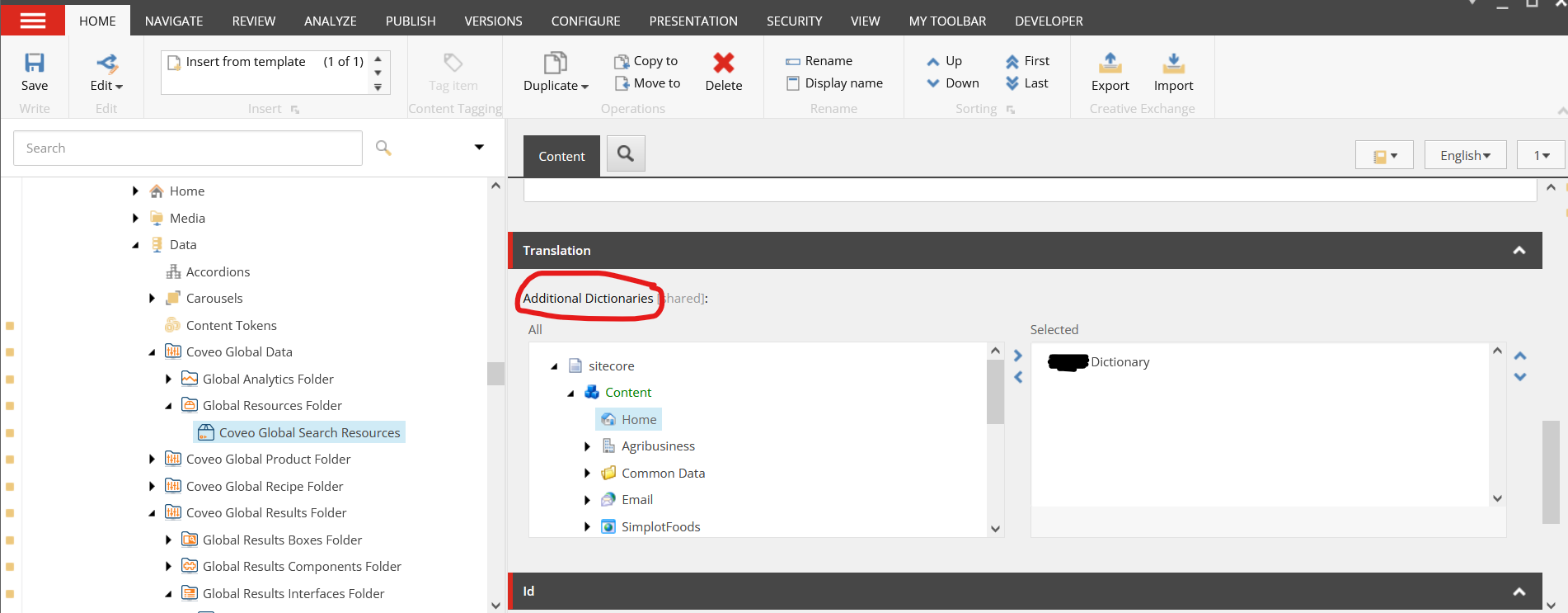
As Article suggested, I have verified both the conditions, firstly checked extranet/Anonymous(user and domain configure with Site Definition) has read access to both Sitecore/System/Dictionary items and additional dictionary item configured at the Coveo Search Resource Data source item. Secondly, checked we have correct dictionary item selected under the field Additional Dictionaries for Coveo Search Resources item configured as data source to respected UI component.
Now, I was trying to isolate the issue, to make sure the issue is due to either dictionary or its child items. So, I tried to remove the dictionary item form the additional dictionary field, publish the item and magically all the broken Coveo Pages started working…!!!
So now, I am sure there is something to do with the dictionary item for that SXA website.
The Solution
I started decoding the Coveo Search Resources SXA UI component and found the logic for getting the component properties have a validation which validates the unique dictionary keys under the selected dictionary.
This is a great lead…..!!!(it took me fair few hours of dotPeeking to find this out) That left me with great confidence that there are some dictionary entry item which has the duplicate value in the Field Key.
I did first obvious check of unique item name by turning validation rule on via Sitecore’s Content Editor’s left gutter.
But none of the dictionary entry items have duplicate name. So now, I need to relay on my Poweshell skills to find the duplicate value on Key field of item /sitecore/templates/System/Dictionary/Dictionary entry.
I removed that unwanted entry item which is lately added by one of the content editor while copying dictionary entries from older SXA website to the new one.
Recently, I am working on an upgrade project (which you must have been knowing if you read few of my recent blogs) and we encountered one very weird issue on Sitecore CM.
The Issue
After successful login to CM, the Launchpad is not showing any icons.
The Solution
First obvious thing I did was open the developer toolbar and inspected the icon image requests under the network tab and it was looking like below image.
All the request to icon images were getting HTTP500 internal server errors. Also observed that .aspx extension is being added at the end of the image extension. For example, /-/icon/LaunchPadIcons/48×48/desktop.png.aspx.
Just dig around the issue, and it turned out, we recently updated the Nuget page reference for the SharpZipLib library to the latest version 1.3.3 for one of the project in customization solution.
The OOTB(vanilla) Sitecore 10.2 also uses the same library but with different version of it.
We matched the version of ICSharpCode.SharpZipLib.dll with the version number come as Vanilla Sitecore Version 1.3.2 and magically all the icons on launch page started appearing again.
Recently we have got an weird issue reported by our content authors on production. They mentioned the content are not reflected on website after they been publish or even re-publish.
First I wanted to check does the Publishing service doing all right and publishing contents correctly. Checked and it was working absolutely fine. I did switch to web database and validated recently published content. After some initial trouble shoot, discovered on CDs, the cache is not been clearing upon successful publish.
This leads my thought to suspect event queue table may have been flooded with lots of entry and may need a clean.
Did a eventqueue table cleaning as mentioned here and things did not went to normal. Still published changes were not reflecting on the website.
Now, I need to dive into detail to understand what is happening in eventqueue table.
The Properties table holds the last event execution time stamp against all the CDs.
To get that last run timestamp follow below steps:
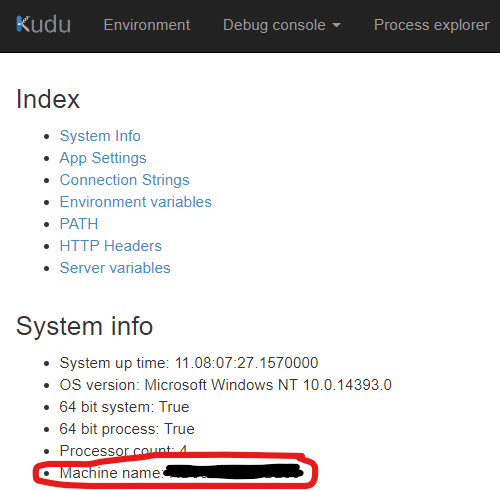
go to your web app and open the Kudu advance tool.
Navigate to Environment page from menu in header
Get the Machine Name from System Info section
Open SSMS and connect to Database
Open new query window for the database which is configured as your Event Queue database( in our case we have configured dedicated one. By default it is web)
Run below query to get the last run time stamp for that CD instance
SELECT * FROM Properties where Key LIKE '%WEB_EQSTAMP_<<MACHINENAME>>%' ORDER BY Value DESC
Replace<<MACHINENAME>> in above query with machine name from step 3 above
Depending on how may instances your selected CD is running, it will show you that may rows (by default there will be two rows for each CD. one is for Production instance and another for pre-prod instance). The value column holds the Time stamp value of last run.
Now, that we have the last run time stamp for the CD, we can get the list of all pending events for this CD instance by running below query.
SELECT * FROM EventQueue WHERE Stamp >= CONVERT(VARBINARY, <<TIMESTAMP>>) ORDER BY Created DESC
Replace the <<TIMESTAMP>> with the value from previous query.
By combining all queries together, the final query will look like below
SELECT * FROM EventQueue WHERE Stamp >=
  (
    SELECT CONVERT(VARBINARY, Value) from [Properties] where [Key] = 'WEB_EQSTAMP_<<MACHINENAME>>'
  )
  ORDER BY [Created] DESC
After all this investigation, it is clear that CD servers are not triggering remote events registered in dedicated event queue table.
Did little more investigation and found out wrong event queue configuration files has been deployed to CDs accidentally and that was causing this behavior. We placed the correct config files for dedicated event queue and the peace has been established on CD role again.
While you have a high functional developers team working on multiple Sitecore projects with same code base, it is very vital to keep the local development environment as stable and functional as possible and also keep PR short.
While achieving that stage, we came across one small issue which is intern made me to write a blog in my journal what you are reading now.
The Issue
While reviewing PRs, we observed, there is one Unicorn’s .yml file come as default to quite a few PRs. The change it has got was just few fields updated.
After quick initial investigation, found out that yml file is nothing but one of the Data Exchange Framework(DEF) batch processing item in Sitecore content tree under system node.
After bit more investigation, it turns out the sitecore’s schedule task is triggering that DEF batch process. But that raise another question, why that schduler task item is not coming as changed item list as it is also source controled using Unicorn.
The Resolution
Lets focus on the second question for now, as it has quite a quick and simple answer.
The \App_Config\Include\Unicorn\Unicorn.config has one section called <fieldFilter> which takes care of it. As few frequently value changing fields has already been excluded from being serialized (smart stuff Unicorn Developers).
That section is looking like below
<fieldFilter type="Rainbow.Filtering.ConfigurationFieldFilter, Rainbow" singleInstance="true">
					<exclude fieldID="{B1E16562-F3F9-4DDD-84CA-6E099950ECC0}" note="'Last run' field on Schedule template (used to register tasks)" />
					<exclude fieldID="{52807595-0F8F-4B20-8D2A-CB71D28C6103}" note="'__Owner' field on Standard Template" />
					<exclude fieldID="{8CDC337E-A112-42FB-BBB4-4143751E123F}" note="'__Revision' field on Standard Template" />
					<exclude fieldID="{D9CF14B1-FA16-4BA6-9288-E8A174D4D522}" note="'__Updated' field on Standard Template" />
					<exclude fieldID="{BADD9CF9-53E0-4D0C-BCC0-2D784C282F6A}" note="'__Updated by' field on Standard Template" />
					<exclude fieldID="{001DD393-96C5-490B-924A-B0F25CD9EFD8}" note="'__Lock' field on Standard Template" />
				</fieldFilter>
So now, for my initial issue to fix , I simply have to add a field I wanted to exclude form being serializedin to this fieldFilter section.
So, I created new patch configuration file (as best practice suggests) an try to patch my new exclude fields under the node <fieldFilter>. At first, I did add the config like following
<configuration xmlns:patch="http://www.sitecore.net/xmlconfig/" xmlns:role="http://www.sitecore.net/xmlconfig/role/" xmlns:environment="http://www.sitecore.net/xmlconfig/environment/">
	<sitecore role:require="Standalone or ContentManagement">
		<unicorn>
			<defaults>
				<!--
					The field filter can be used to ignore fields when comparing or serializing (i.e. don't write them to disk).
					Commonly, metadata fields such as Last Updated will be ignored to prevent SCM conflicts.
				-->
				<fieldFilter>
					<exclude patch:after="exclude[@fieldID='{001DD393-96C5-490B-924A-B0F25CD9EFD8}']" fieldID="{985BA535-0F3E-4DA8-A768-A469026DE9DB}" note="'RequestedAt' field of DEF's Pipeline Batch item" />
					<exclude patch:after="exclude[@fieldID='{001DD393-96C5-490B-924A-B0F25CD9EFD8}']" fieldID="{6A2B2CBB-4338-4814-A8A9-9FECBB90456A}" note="'LastRunFinished' field of DEF's Pipeline Batch item" />
					<exclude patch:after="exclude[@fieldID='{001DD393-96C5-490B-924A-B0F25CD9EFD8}']" fieldID="{2AA5C591-FF55-411D-96C0-978BB2C58B94}" note="'Log' field of DEF's Pipeline Batch item" />
				</fieldFilter>
			</defaults>
		</unicorn>
	</sitecore>
</configuration>
But this has weird patching when I see showconfig.appx. It actually replaces first three entries form the original xml…!!!???
I did ask God(google) and found that sitecore sometime does not patch correctly if proper attributes are not used. Someone suggest to use hint attribute to control the patching.
I did replace my patching config attribute note with the hint and eureka….!!!
This is the final configuration patch file looks like.
<configuration xmlns:patch="http://www.sitecore.net/xmlconfig/" xmlns:role="http://www.sitecore.net/xmlconfig/role/" xmlns:environment="http://www.sitecore.net/xmlconfig/environment/">
	<sitecore role:require="Standalone or ContentManagement">
		<unicorn>
			<defaults>
				<!--
					The field filter can be used to ignore fields when comparing or serializing (i.e. don't write them to disk).
					Commonly, metadata fields such as Last Updated will be ignored to prevent SCM conflicts.
				-->
				<fieldFilter>
					<exclude patch:after="exclude[@fieldID='{001DD393-96C5-490B-924A-B0F25CD9EFD8}']" fieldID="{985BA535-0F3E-4DA8-A768-A469026DE9DB}" hint="'RequestedAt' field of DEF's Pipeline Batch item" />
					<exclude patch:after="exclude[@fieldID='{001DD393-96C5-490B-924A-B0F25CD9EFD8}']" fieldID="{6A2B2CBB-4338-4814-A8A9-9FECBB90456A}" hint="'LastRunFinished' field of DEF's Pipeline Batch item" />
					<exclude patch:after="exclude[@fieldID='{001DD393-96C5-490B-924A-B0F25CD9EFD8}']" fieldID="{2AA5C591-FF55-411D-96C0-978BB2C58B94}" hint="'Log' field of DEF's Pipeline Batch item" />
				</fieldFilter>
			</defaults>
		</unicorn>
	</sitecore>
</configuration>
After this, Unicorn re-serialized the DEF pipeline batch items and happy days….!!!!
Note:
There is new feature “fieldTransforms” available in Unicorn 4.1 and later version but I have not able to get that working on my project setup. But, something worth exploring for next time.
While working on the integrating Sitecore’s CM’s functionality with third party Digital Asset Management(DAM) system, I came across one interesting issue where I wanted my container applications to run on https.
The Issue
After integrating the third party DAM with Sitecore CMS, it found out that, while using local website on developer machine, the developer is not able to load the SSO login page. While loading that page below error messages logged in browser’s console.
Access to the WebCrypto API is restricted to secure origins. Compact View requires HTTPS when used outside localhost (for development).
As clearly stated I am not using localhost as host to access my cm and seems like CM needs to be securely severed over https where as we, for local development, use non secure protocol http.
The Fix
The solution is simple looking form 35,000 feet. Needs CM urls to be serving content over the secure HTTPS protocol. But when actually started digging in details, it is fun and very learning experience.
Performed following steps to achieve this on our local docker development environment.
Open the startup/createcert.ps1 for editing and change following parameter’s default value
$certificatepassword – from b to more secured passowrd string
$dnsNameList – by default the value is *.dev.local. Change this value to match your host pattern. You can specify individual host comma(,) separated.
Note
Alternatively, you can can pass those two as parameter while firing createcert.ps1 command.
3. Open docker-compose.yml file and navigate to cm service and perform following changes:
Add new environment parameter HOST_HEADER and set cm host value to it. If you have multiple host(this is what in my case), specify them semicolon(;) separated list. For example host1.dev.local;host2.dev.local
Under the volumes bind the new volume for folder startup to c:\startup path of container.
Under the port bind the https’s default secure port 443 with the next available container port
Note
The container host port needs to be new port which is not been use by any other services.
Lastly, change the entypoint to the path of startup.ps1 file under the startup folder bound under the volumes in above step for startup folder.
After all above changes to CM service of docker-compose.yml file will look something like below
4. Copy folder startup and it’s content to same folder where your docker-compose.yml file is.
5. Open the powershell in elevated mode and execute following command
PS> cd <<docker-compose.yml file's folder path>>
PS> ./startup/createcert.ps1
Above powershell script will generate three files cert.cer, cert.pfx and cert.password.text under the startup folder.
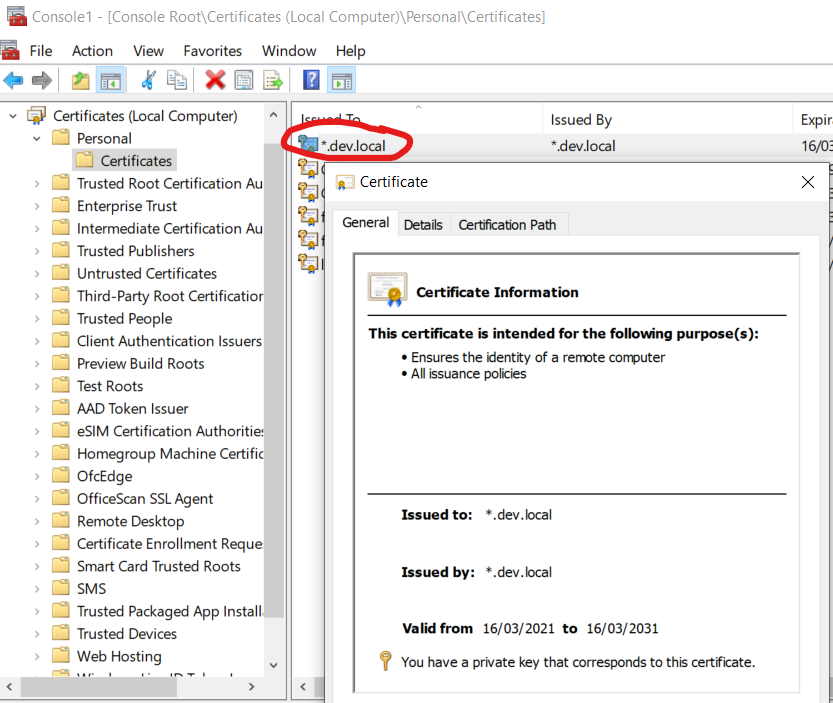
This command will also generate the self-signed wildcard certificate and install to your system’s local certificate store under personal.
To verify that run mmc and open local computer certificate store.
Self signed wildcard certificate for *.dev.local
6. Now, is the time to fire up the container for sitecore. To do so run following docker compose command
PS> docker-compose up -d
After successful execution the container services will be up and one can access the host binding with https. For example https://cm.dev.local in this case.
Advance trouble shooting
To check the certificate is exist after the createcert.ps1 script execution. This command can be run on both your local and against cm container as well.
The QA team, we are working with has raised a very interesting issue while testing newly created data report using Sitecore Poershell Extenstion(SPE).
The Issue
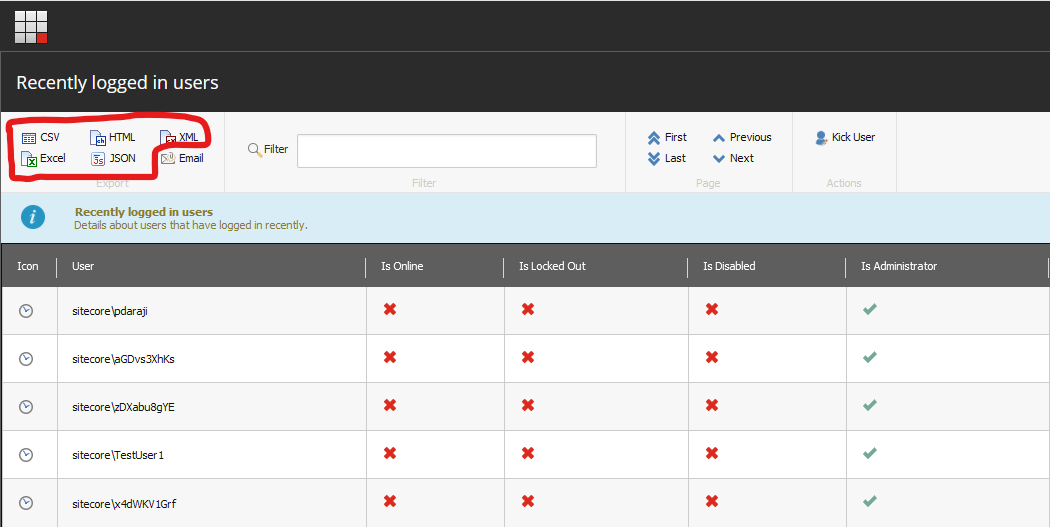
The data report was executing perfectly but while trying to export the data in any of pre-defined formats offered by SPE, it was not working.
The Sitecore Powershell is allowing export of report data in various industrial standard formats out of the box as listed below:
CSV
HTML
XML
Excel
JSON
These formats have option links in the ribbon above but when clicking, none of those producing any output.
¯\_(ツ)_/¯
The Investigation
First step is to try to reproduce the issue. We tried on all the available environments and it is happening on every environment except for the local environment.
I though the issue may have to do with some missing config or SPE. So, we quickly try to re-install the SPE module on CM with no over-write option for both files and content on Integration Environment. But that does not fix the issue. ☹
So, we started listing what are the major difference from modules and features point of view between local development and other environments on Azure. It turns out that all other environments have exactly the same piece of code, configurations and modules installed except for Federated Authentication using Sitecore Identity Server for CM.
The Fix
We did quick search over the internet and one of my colleague found out that there is one file which is disabled for SPE which needs to be enable if we are using sitecore 9.1 and higher(we are running 9.3) along with identity server.
The file needs to be enabled is Spe.IdentityServer.config file which is part of the SPE package.
Once package is installed, the file is located at path <<website Root>>\App_Config\Include\Spe\Spe.IdentityServer.config.disabled. The content of this disabled file is as below.
<configuration xmlns:patch="http://www.sitecore.net/xmlconfig/" xmlns:role="http://www.sitecore.net/xmlconfig/role/" xmlns:security="http://www.sitecore.net/xmlconfig/security/">
  <sitecore role:require="Standalone or ContentManagement" security:require="Sitecore">
    <pipelines>
      <owin.cookieAuthentication.validateIdentity>
        <processor type="Sitecore.Owin.Authentication.Pipelines.CookieAuthentication.ValidateIdentity.ValidateSiteNeutralPaths, Sitecore.Owin.Authentication">
          <siteNeutralPaths hint="list">
            <!-- This entry corrects the infinite loop of ExecuteCommand in the SPE Console -->
            <path hint="spe">/sitecore%20modules/PowerShell</path>
          </siteNeutralPaths>
        </processor>
      </owin.cookieAuthentication.validateIdentity>
    </pipelines>
  </sitecore>
</configuration>
Tip: The best way to get these config enable in Docker container world, is to leave the above mentioned .disabled file as is. Create new configuration file with above content in Visual Studio solution deploying to z folder under app_config\include on your binding volume path which will be taken care by Sitecore config patching.





 Cooking with Sitecore